Later years bring real changes: loss, health worries, quieter days, and thoughts that can circle at night. It is easy to assume that is just how aging feels. It does not have to be. CBT gives you practical tools to gently retrain those anxious patterns, and unlike medication or costly programs, you can begin with nothing more than a pen and a few quiet minutes.
Does CBT really work for older adults?
Yes. CBT is among the best-studied approaches for late-life anxiety and depression, and research consistently finds older adults benefit from it. The reason is that CBT is skill-based, not age-based. It teaches you to spot the link between a thought, a feeling, and an action, and then to change the part you can. That is a learnable skill at any age.
Four simple CBT exercises to start today
1. The thought record
When a worry hits, write it down word for word. Then ask three questions: what is the evidence for this thought, what is the evidence against it, and what is a more balanced way to see it? Getting the thought onto paper and testing it against the facts takes much of its power away.
2. Catch the thinking trap
Anxiety loves a few predictable traps: expecting the worst, treating a feeling as a fact, or seeing things as all-or-nothing. Just naming the trap ("that is me catastrophizing") creates a small, helpful distance between you and the thought.
3. Behavioral activation
Low mood whispers "do less," and doing less deepens the low mood. Behavioral activation gently reverses it. Each day, plan one small, pleasant, or meaningful activity, a short walk, a phone call, a hobby, and do it whether or not you feel like it. Action comes first, and the motivation tends to follow.
4. Scheduled worry time
Set aside fifteen minutes a day as your "worry time." When worries surface at other times, note them down and tell yourself you will deal with them then. It sounds almost too simple, but it stops worry from leaking into the whole day.
Why text-based works best for seniors
Most CBT tools today are apps, videos, and logins, exactly the barriers that make many older adults give up. A simple, text-based workbook removes all of that. Short daily prompts you read and write keep the focus on the exercise, not the technology, so the habit actually sticks.
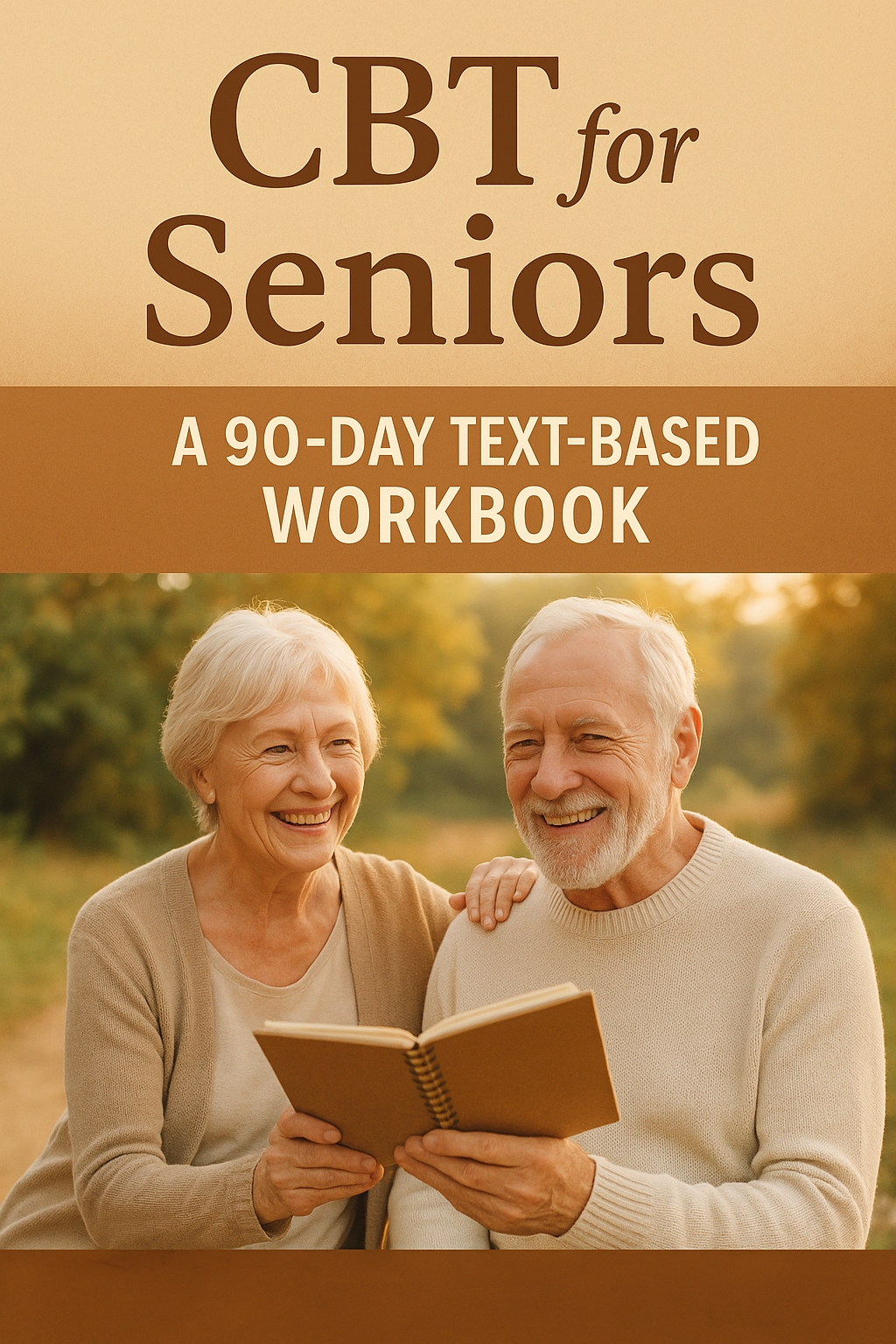
The 90-day workbook
CBT for Seniors
A gentle, 90-day text-based workbook that turns these exercises into one small step a day. No app, no video, no jargon, just clear prompts at your own pace.
See the bookFrequently asked questions
Does CBT work for older adults?
Yes. It is one of the most studied and effective approaches for late-life anxiety and low mood. The skills are practical and learnable at any age.
What is a simple CBT exercise for anxiety in seniors?
The thought record: write the worry down, then weigh the evidence for and against it and find a more balanced view. Testing a thought on paper takes its power away.
Can a senior do CBT without a therapist?
Often yes, with a self-guided workbook at your own pace. It pairs well with professional care, but it is not a substitute for it, especially in a crisis.
For a lighter daily practice, see The 90-Day Gratitude Mind Reset, or read more on the blog.